
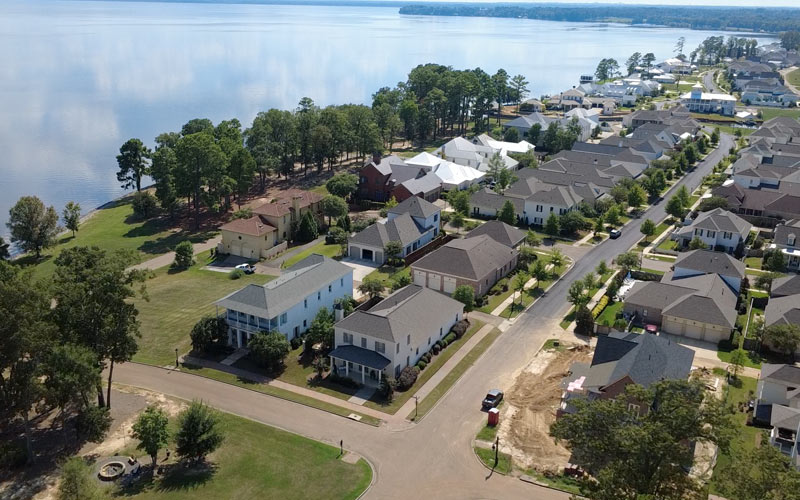
As central Mississippi finally shakes off the summer heat, fall brings another season around the Ross Barnett Reservoir: home improvement season.
Cooler weekends make it a lot more appealing to replace a fence, repair a roof, build a storage shed or finally tackle that project you’ve been putting off since May. But if you live on property within the Pearl River Valley Water Supply District, there may be another item to put on the project list before buying lumber or calling a contractor — a permit.
The PRVWSD Building Department oversees construction and property improvements within District subdivisions in both Rankin and Madison counties. And the list of projects requiring permits is probably longer than some Reservoir residents realize.
It’s Not Just New Construction
It probably comes as no surprise that building a new home or commercial building requires a permit. The same is true for major waterfront projects such as seawalls, boathouses and piers.
But PRVWSD’s permit requirements go well beyond major construction.
The District says permits are also required for repairs, additions and renovations to existing structures and driveways. Electrical, mechanical and plumbing upgrades are on the list as well, along with roofing, fencing and foundation repairs.
Accessory buildings such as backyard storage buildings require permits, as do swimming pools. Demolition also requires a permit.
There are some less-obvious items on the District’s list, too. Mobile homes, PODs, signs and temporary banners require permits. Even garage sales are included among activities requiring a permit.
In other words, don’t assume that a project is too small to require approval simply because you aren’t adding square footage to your house.
Thinking About a Shed, Shop or Other Accessory Building?
Fall is a popular time to add storage, particularly after spending another summer looking at lawn equipment taking up half the garage.
PRVWSD requires a building permit application and site plan showing the proposed location of an accessory building. Generally, accessory buildings must be at least 10 feet from the rear and side property lines unless subdivision covenants specify otherwise. They are prohibited in front or side yards.
If the building will be visible from the street, PRVWSD says it must use materials similar to those of the existing house. HOA or Architectural Review Committee approval is also required where applicable.
A setback inspection is required for these projects.
Roofs and Fences: Repair Is Different From Replacement
Two projects that can easily create confusion are roofing and fencing. The important distinction is between making a minor repair and replacing all or a substantial portion of what is already there.
If a few fence boards are damaged, replacing those individual boards as part of normal maintenance does not require a permit. The same applies to replacing a few damaged shingles or roof tiles. Those are considered repairs rather than replacement projects.
But if you’re replacing the fence or putting on a new roof, that’s different. PRVWSD requires a building permit application for fence and roof replacements, along with HOA or Architectural Review Committee approval where applicable.
PRVWSD’s current requirements state that an inspection is not required for those particular permits.
That’s a useful distinction for homeowners planning fall maintenance: fixing a few damaged pieces isn’t the same as replacing the structure. If a repair starts growing into a larger replacement project, that’s a good point to check with the Building Department before continuing.
Renovating or Adding Onto the House?
Repairs, additions and renovations can also require District approval.
Depending on the project, PRVWSD may require a site plan showing setbacks along with electrical, mechanical, foundation and framing information. Additions and exterior renovations may also require HOA or ARC approval.
The District separately lists electrical upgrades, mechanical upgrades and plumbing upgrades among work requiring permits.
Foundation repairs have their own requirements. The permit application must include a drawing showing where repairs will be made, and that drawing must be stamped by an engineer licensed in Mississippi.
Pools Require a Site Plan
A new swimming pool requires more than finding enough room in the backyard.
PRVWSD requires a building permit application and site plan showing the proposed pool and its setbacks from property lines. HOA or ARC approval is also required where applicable.
Because FEMA flood maps are checked during the permitting process, properties located within a special flood hazard area may require additional paperwork.
Waterfront Projects Get Additional Scrutiny
Projects at the water’s edge have additional requirements.
Shoreline protection projects such as seawalls require a permit application and construction drawings identifying the materials to be used. Those drawings must be stamped by an engineer, and the work must be inspected by a licensed third-party professional, with copies of those inspections provided to PRVWSD. Approval from the U.S. Army Corps of Engineers may also be required.
New construction, remodeling and renovation of boathouses and piers also require a permit. Applicants must provide a site plan showing the location and setbacks, construction drawings and materials, and HOA or ARC approval where applicable.
PRVWSD limits boathouses and piers to no more than 32 feet from the waterside of the lease line, and the structures must remain between the projected side lease lines of the residence. Corps of Engineers approval may also be required.
So replacing, enlarging or substantially modifying an existing waterfront structure shouldn’t begin with the assumption that it’s simply a repair.
Don’t Forget the HOA
A PRVWSD permit and neighborhood approval can be two different things.
For several types of residential projects, the District specifically requires HOA or Architectural Review Committee approval where applicable. That includes residential construction, exterior renovations and additions, accessory buildings, pools, fencing and roofing, as well as boathouses and piers.
Getting one approval doesn’t necessarily eliminate the need for the other.
Check Before You Start
Perhaps the biggest takeaway for Reservoir homeowners is that the permitting requirements aren’t limited to the projects most people traditionally think of as “construction.”
A new boathouse obviously deserves a call to the Building Department. A new roof, fence, driveway repair, electrical upgrade or backyard storage building might not seem quite as obvious — but they’re included on PRVWSD’s permit list.
And because the District broadly includes repairs and renovations to existing structures, homeowners shouldn’t rely on assumptions about whether a particular project is minor enough to proceed without a permit.
If you have any doubt about whether your fall project requires a permit, contact the Pearl River Valley Water Supply District Building and Permitting Office directly before beginning work. The office can be reached at 769-243-7014 or [email protected].
A quick question before the project starts is considerably easier than discovering halfway through it that a permit was required.