
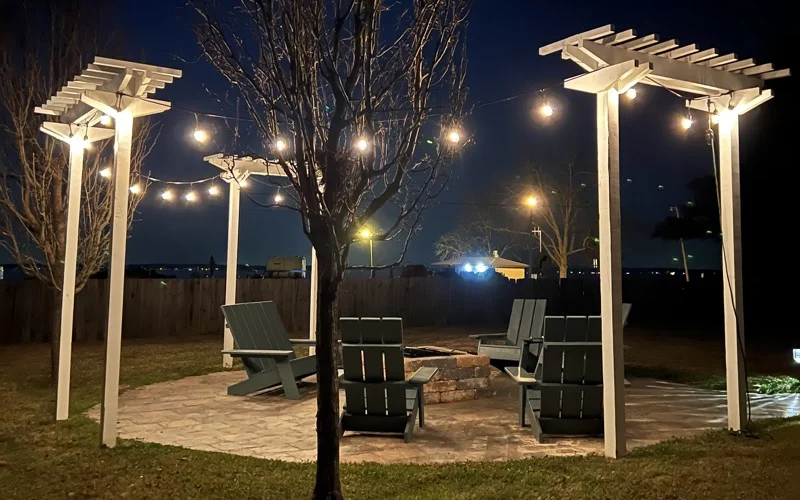
Outdoor lighting near the Reservoir has two jobs. It should help people move safely, and it should stop where the property stops. The second job is easy to miss because open water carries glare farther than a backyard fence would. A fixture that looks modest from the porch can appear like a headlight from across the cove. Good lighting begins with admitting that our nighttime view includes everyone else’s lights too.
Walk the route people actually use after dark. Notice steps, changes in level, gates, doorways and the path between the house and dock. These are the places that need clear, reliable light. A row of smaller fixtures near the walking surface often works better than one powerful lamp mounted high above everything. Light the feet and the task, not the entire shoreline.
Point the Beam Down
Shield fixtures so the bulb is not directly visible from the water or neighboring property when possible. Aim task lights toward cleats, steps and work surfaces rather than the horizon. Choose only the brightness required for the job. Warmer, lower-intensity lighting often feels more comfortable to eyes adjusting to darkness than a harsh blue-white flood. The purpose is to see, not to announce.
Test the setup from several angles after installation. Stand at the property edge, look from bedrooms and walk toward the house from the dock. If a new light makes it difficult to see anything beyond the beam, it may be too bright or poorly placed. Ask a trusted neighbor across or down the shoreline whether glare reaches them. We cannot judge every effect from the chair beneath the fixture.
Separate Work Light From Porch Light
A boat arriving after dark may require focused light while people tie lines and unload. Keep that task lighting available and use it for the necessary period, then switch it off when the dock is secure. The porch may need only a softer fixture near the door and seating area. Treating those as separate needs allows both to work better. A floodlight left on all night is usually performing neither job well.
Timers, dimmers and motion controls can help when they match real use. A motion light triggered all night by branches, insects or animals becomes its own form of disturbance. Adjust sensitivity and duration according to the equipment and location. Make sure controls are simple enough for guests and family members to use. The best system is not the one with the most settings; it is the one people remember to turn down.
Decorative lighting deserves restraint as well. String lights can make a screened porch warm and comfortable, but several layers of decorative and landscape lighting can erase the night without improving safety. Begin with fewer fixtures and live with them before adding more. Notice reflections on water and glass. Darkness between lights is not a design failure.
Preserve the View We Came Here For
Reservoir nights offer stars, moonlight and the soft line of the far shore. Bright property lighting makes those details harder to see and can disturb neighbors who are sleeping or sitting outside. Wildlife also uses the shoreline after dark, and unnecessary light changes the environment they move through. Turning off what is not needed is the simplest improvement. It also costs less than illuminating an empty dock until dawn.
Useful outdoor lighting is quiet. It shows the next step, helps us secure the boat and welcomes people through the door without demanding attention from the entire cove. Point it down, keep it warm and switch it off when the work is done. The Reservoir already provides the nighttime view. Our job is not to wash it out.