
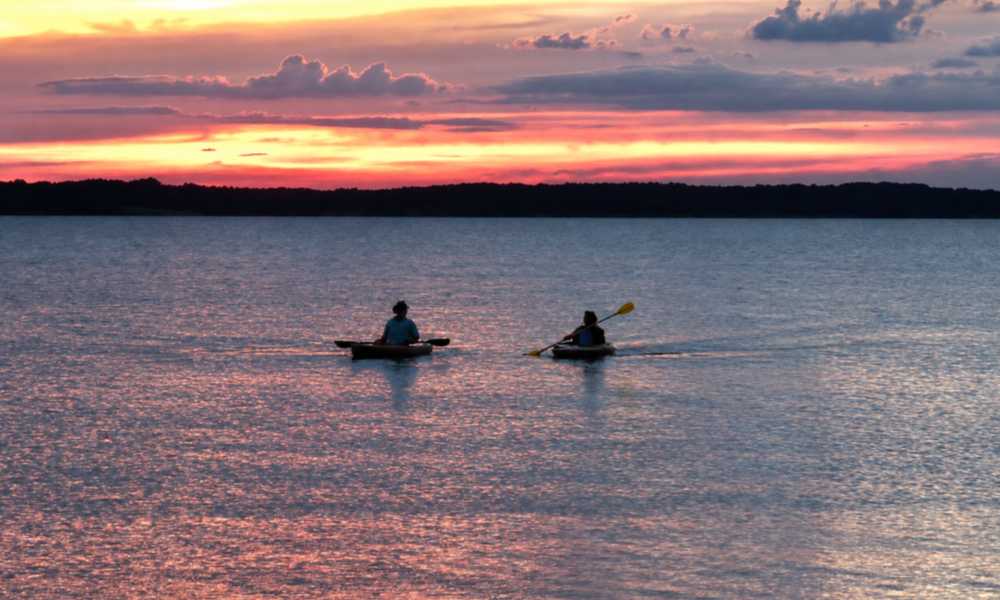
When I moved to the Reservoir in 2001, I assumed just about everyone who lived here owned something that floated. A ski boat, a couple of Jet Skis, a pontoon, a kayak, or a paddleboard seemed like part of the deal. Why live so close to all that water without getting out on it?
Over the years, that assumption has changed. We’ve owned a couple of Jet Skis and still own multiple kayaks, but I don’t see nearly as many people on the water as I expected. My impression is that many of our neighbors, perhaps even most, don’t own a watercraft at all. That’s an observation, not a survey, but it has made me think about how easy it is to live beside the Reservoir without experiencing much beyond the view.
There are plenty of understandable reasons. Equipment costs money, boats need storage, and getting everything to the water takes effort. Some people aren’t comfortable out there, while others simply have different interests. But for anyone who has looked across the Reservoir and thought, “I really ought to get out there sometime,” paddling is worth considering.
Not because you need another hobby to keep up with, but because it offers something many of us could use: a little room to breathe.
The freedom of going at your own pace
There’s a particular appeal to moving across the water under your own power. Every paddle stroke takes you somewhere, but there’s no requirement to go far. You can follow a suitable stretch of shoreline, watch a bird working the shallows, or pause for a moment and take in a view you usually pass at road speed.
A paddle doesn’t have to become an expedition. A short outing in calm, protected water can be enough to change the feel of an afternoon. You aren’t trying to see the entire Reservoir or prove how athletic you are. You’re simply spending some time on the water, moving at a pace you choose.
That freedom is part of what makes kayaking, canoeing, and paddleboarding appealing. So much of an ordinary day involves responding to someone or something. Out on the water, with your phone tucked away but available for an emergency, your attention has somewhere else to go.
Giving your mind a different place to be
Think about how often we fill a spare moment by checking a screen. Even our downtime can become another stream of news, messages, and things to remember. Paddling offers a different kind of attention: the sound of water against the hull, the placement of the next stroke, the breeze, and the shoreline ahead.
Researchers use the term “blue space” for outdoor environments that feature water, including lakes, rivers, and coastlines. A systematic review of research found that greater exposure to these spaces was associated with better mental well-being and higher physical activity. The researchers also noted that more work was needed to understand cause and effect. That doesn’t mean a kayak ride guarantees a better mood, but it supports the idea that time around water can be part of a healthy routine.
For Reservoir residents, the invitation is close to home. We don’t necessarily have to wait for a beach vacation to spend time around open water. With the right equipment, skills, and conditions, we can make that experience part of an ordinary weekend.
Exercise with something to look forward to
Paddling also gives your body something useful to do. The Mississippi Department of Wildlife, Fisheries, and Parks describes it as a full-body workout that can be both relaxing and physically challenging. Your effort depends on your pace, technique, equipment, and conditions, which is one reason beginners should start with manageable outings and learn proper technique.
The broader benefits of physical activity are well established. According to the CDC, moderate-to-vigorous activity can reduce short-term feelings of anxiety and improve sleep, while regular activity provides longer-term health benefits. A paddle can contribute to that activity when the effort is sufficient, although drifting and sightseeing won’t provide the same workout as sustained paddling.
Still, enjoyment matters. An activity you look forward to has a place in your life that another obligation may never find. If watching the shoreline go by makes movement more appealing, that is a good reason to give it a try.
You don’t have to buy a kayak tomorrow
Owning equipment isn’t the only way to find out whether paddling suits you. Consider a beginner lesson, a guided outing, or borrowing suitable equipment from someone experienced who can help you learn. Check availability and what instruction is included before making plans, and try different options before committing to a purchase.
Being comfortable matters more than looking adventurous. Learn how to enter and exit the craft, steer, stop, and respond if you capsize. Make sure the equipment fits your size and abilities. A first outing should leave you interested in another one, rather than exhausted and wondering how you’ll get everything back to the car.
Families can keep the same approach. Choose a short, achievable outing with capable adult supervision and properly fitted life jackets. Leave room for questions, wildlife watching, and an early return if someone has had enough. There is no prize for making a child’s first paddle longer than it needs to be.
Respect the water, even close to home
Familiarity with the Reservoir from a bridge, walking trail, or backyard does not necessarily prepare someone for conditions on the water. Wind and waves deserve particular attention on a large lake, and a pleasant day on shore can still be unsuitable for a beginner.
Before heading out:
- Wear a properly fitted life jacket throughout the outing.
- Check the forecast and actual conditions, including wind, waves, and approaching storms.
- Choose a route suited to your ability, using a permitted access point and identifying where you can return to shore.
- Go with an experienced companion, especially while learning.
- Tell someone your route and expected return time.
- Carry drinking water and a protected means of communication.
- Plan for the water temperature, not just the air temperature.
These precautions reflect guidance from state paddling-safety resources. Cooler weather calls for extra care: a warm afternoon does not make cold water safe, and appropriate cold-water gear and skills may be necessary. Postponing an outing is always an option.
An invitation to experience the place we call home
I no longer assume everyone who moves to the Reservoir will buy a boat. There are plenty of ways to enjoy living here, and admiring the water from shore is certainly one of them. But I do think some neighbors might enjoy paddling more than they expect, particularly if their introduction is simple, comfortable, and shared with someone who knows what they’re doing.
If you already paddle and have suitable extra equipment, consider inviting a friend who has expressed an interest. Help them prepare, choose an easy day, and make the experience about enjoying the water together. Sometimes the difference between “I’ve always wanted to try that” and actually doing it is an invitation.
Back in 2001, I thought living here meant everyone would naturally spend time on the water. Now I think it takes a little more intention. The Reservoir can become part of the background of a busy life, something we cross on the way to somewhere else. A paddle gives us a reason to stop passing by and spend a little time in the place we chose to call home.